


Split Year Classes
Each year, we are able to admit up to 45 children. As class sizes are usually 30 pupils, some children are taught in split year (also known as mixed-age) classes. The only exception to this is for our Reception intake, where we split into two smaller classes of up to 23 pupils.
We are proud to be able to offer split year classes as we believe there are many benefits to being taught amongst peers from a different age group. As the largest Primary School in Henley, every child will have the opportunity to be in a split class at least once.
What is a split year group class?
A split year group class includes pupils from more than one year group. These split year classes run alongside our non-split classes. Please see the diagram below. Our classes are named after famous children's authors.
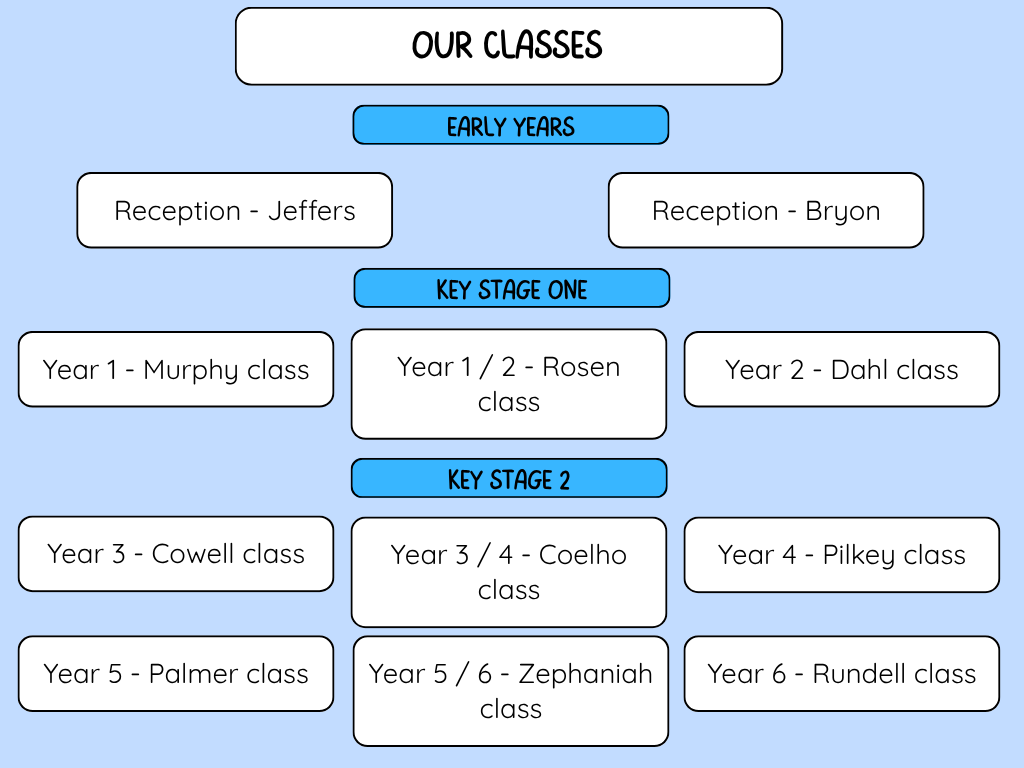
How do we decide who goes into a split class?
Staff use their professional expertise to ensure that each child is placed where they will thrive. Decisions are made carefully for each cohort and consider a range of factors, including:
- social learning groups
- age
- emotional development
- readiness to learn
- stage of learning
- learning style
- additional needs
- balance of gender and age within the class
Parents are informed of class arrangements and are welcome to discuss their child’s placement. The Headteacher, alongside the senior leadership team, makes the final decision, based on professional judgement and what will best support each child’s personal, social and academic development.
How are two year groups taught in one classroom?
Children develop at different rates, and age alone does not determine achievement. Teaching is planned to meet individual academic needs, rather than being based solely on year group.
All classes contain a wide range of abilities. Teachers select work appropriate to each child’s level, ensuring all pupils are supported and challenged as needed.
Most lessons take place as a whole class, although staff plan creatively so that pupils are taught what they are needed in the way that will help them learn best. Sometimes teachers teach one group of children at a time for short periods within a lesson, while the others do an activity or work independently. This is how all classes at school work, but this can happen more in the mixed class.
Will my child be held back by being in a class with younger children?
No. Teaching in primary schools is designed to meet individual needs and current attainment levels. Our staff are experienced in planning for mixed-age classes and ensure that all children are appropriately challenged or supported.
Children in the same year group follow the same curriculum as their peers, and teachers work collaboratively within each Key Stage to plan learning. School performance data at the end of Key Stage 1 and Key Stage 2 shows no negative impact on attainment for children in mixed-age classes.
Research also suggests that some children perform better in classes with a wider age range, as this allows greater flexibility in grouping by ability. Children who need extra support receive it in the same way as in single-year classes, while those working above expectations are given opportunities to deepen and extend their learning.
What are the benefits of split year classes?
Split year classes offer many benefits. Children have opportunities to build positive relationships with peers of different ages. Older pupils can support younger ones, helping to develop confidence and leadership skills. Older pupils enjoy being ‘role models’ to younger pupils and in turn, younger pupils benefit from seeing positive behaviours modelled by their older peers. There is often a strong sense of cooperation and more opportunities to work with a wider range of peers.
How does this affect friendship groups?
Great care is taken when allocating pupils to classes. Teachers use their knowledge of each child to ensure social needs are considered and supported.
While maintaining friendships is important, it is also beneficial for children to widen their circle of friends. Opportunities are provided beyond the standard curriculum — such as playtimes, lunchtime activities, trips and performances — so that children can continue to spend time with friends in other classes.
This experience also prepares children for secondary school, where they will regularly work with different peers.
Do split and non-split classes mix?
Yes. Some lessons are taught by Year group and pupils mix during playtimes. We have also developed the wider curriculum in such a way as to offer lots of opportunities for split and non-split classes to mix, for example swimming lessons, the KS1 nativity, the Year 4 play, the Year 6 end of school production and various sporting events.
How will my child feel if they are allocated to a split class?
At Trinity, mixed-age classes are the norm, so children generally do not feel any different being in a split class. Parents can support this by focusing on the positives.
Children are helped to understand that:
- each year group has different expectations and work
- lesson outcomes are age-appropriate
- expectations vary based on individual progress, not just age
All lessons are differentiated to meet individual needs, whether classes are split or not.
How do we cover the curriculum?
All areas of the National Curriculum are taught across the appropriate Key Stages.
- Most lessons are taught as a whole class, with flexible planning to meet different needs
- Teachers may work with one year group while others work independently or with a Teaching Assistant
- Activities are rotated so children are not always working with adults or independently
- Tasks are differentiated to provide appropriate support or challenge
- Some discussions are organised by year group, depending on the subject
- Spellings are selected from year-group spelling lists and children are tested on their own list
- Where the curriculum specifies year-group objectives, these are taught to the correct year group
Phonics and Maths
- Year 1 children receive phonics teaching
- Year 2 children who need additional phonics support may join these sessions
- Year 2 follows the Little Wandle spelling programme
- Maths follows White Rose Maths, which supports mixed-age teaching and is adapted to suit the class
In Key Stage 1, there is a strong focus on securing number facts and operations, with plenty of opportunities for reinforcement, independent practice, and small-group support.